Pader Community Technology Center Workshop
Working on bikes
David from Bikes Not Bombs, Denis and Wokorach from Pader
Bernard and me demonstrating the GCS phone charger
Bernard showing the charcoal crusher
Bernard attaching the charcoal crusher to a bicycle
The charcoal crushing mechanism
Running the charcoal crusher
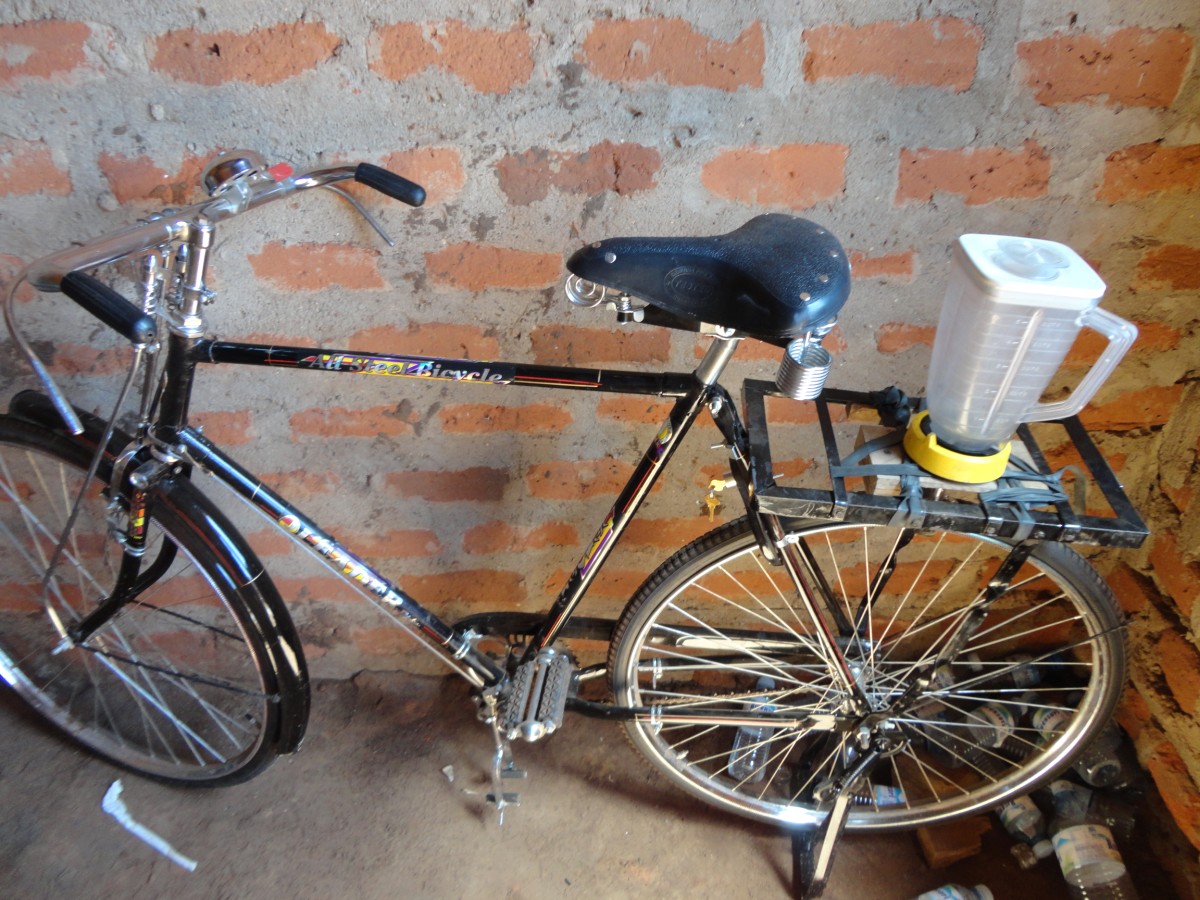
Bicycle blender
Testing out the bicycle blender
Running the cassava grater
The added safety mechanism for the cassava grater
Cassava grater up close
Sorghum thresher design
Building the bicycle water cart
Testing the bicycle water cart
Bicycle water cart attachment
Showing posts with label Friends. Show all posts
Sunday, November 27, 2011
Pedal-power workshop in Uganda
See previous posts: Travel to Uganda and Preparing for Workshop
The workshop was a three day event, but I could only stay for the first two since I had to grab a bus to Nairobi to catch a flight. We started off by demonstrating some bicycle repair and maintenance skills. My station was on repairing flat tires. The one time I tried to fix my own flat, I wound up destroying the whole tire (not just the tube, mind you). Fortunately, I was staying in a guest house with Bernard, so the night before, he showed me how to do it and I got to practice. For the demo, four different groups came through and we looked at different types of tires (regular, racing and mountain) and then I used my nail to make a puncture as we all took turns using the tire iron, applying the patch and then checking for additional leaks. The participants also learned how to pack a bearing, how to spoke a tire and how to work on a chain.
After that, there was a session on identifying challenges, but I had to miss that one. After lots of hassle, we got a box of GCS equipment that morning (phone chargers and corn shellers), so I spent my time setting the kit up. By the time I finished setting things up (with some help from Bernard, since I was having an embarrassingly difficult time and for some reason couldn't apply basic problem solving skills), they were just finishing up the discussion.
Then, we demonstrated a few technologies that we had set up for the occasion. There was a charcoal crusher* that Bernard designed and built based off a project that he had worked on at IDDS in 2008. There was a peanut grinder using spare bicycle parts (everyone loved this one since we got to eat a sesame-peanut butter concoction that we prepared to show the machine). There was a blender that ran off the back wheel of a bicycle (people also enjoyed the smoothies that came out of this demo).
In the afternoon, we broke off into teams to work on the design challenges that they had chosen. I was working with a team of Caritas staff members who were looking at designing a sorghum thresher. All of the other participants had previously done a workshop with Amy, so they were familiar with the design process, but the Caritas staff had been a last minute addition. It was really interesting to see what it's like trying to design something with people as they try to decide the order of steps themselves (imagine watching someone build a house starting with the roof). I worked with them to try to guide them down the right path (identifying constraints before selecting design elements) and though it was a bit slower than usual, by the end of the day, we had an idea that we were happy with.
The second day was mostly building and testing ideas. It was a bit difficult with the sorghum threshing team since we didn't have dried sorghum that was ready for threshing, but they still produced a pretty nifty machine. Mid-morning we took a break and Bernard and I demonstrated the GCS technologies for everyone. People were really amazed to see the corn sheller work and were also very excited by the bicycle phone charger. Everyone kept passing up their phone to see if it could be charged by the bicycle (they all could). It was really unfortunate that shipping is such an expense, because it definitely drives the price beyond the means of the communities.
All of the sessions were translated from English into Acholi, the local language, by the Caritas staff. I had to leave after the second day, which was really sad. At dinner that night, the participants gave me an Acholi name. They called me Otam, which means the thinker. I think they just saw me constantly staring at bicycles and could hear the wheels turning in my head. I was really touched by everyone there. I was a little disappointing that the only words that I learned in Acholi were "hello" "thank you" and "good". Still, I managed to get pretty far with those as well as lots of wild gesturing.
I also really enjoyed the food in the community. Every morning, we ate a very hearty cassava stew with very sugary tea. Then lunch and dinner were a mixture of greens (but not kale like I usually eat in Kenya and Tanzania) with posho (the Ugandan term for what we call ugali in Kiswahili), rice with beans, peanut stew (really delicious) and roasted goat. We were definitely full at the end of every meal.
* It was fun that this was included, since it meant that Amy and I got to run a charcoal burn the night before to provide the material for the demonstration.
The workshop was a three day event, but I could only stay for the first two since I had to grab a bus to Nairobi to catch a flight. We started off by demonstrating some bicycle repair and maintenance skills. My station was on repairing flat tires. The one time I tried to fix my own flat, I wound up destroying the whole tire (not just the tube, mind you). Fortunately, I was staying in a guest house with Bernard, so the night before, he showed me how to do it and I got to practice. For the demo, four different groups came through and we looked at different types of tires (regular, racing and mountain) and then I used my nail to make a puncture as we all took turns using the tire iron, applying the patch and then checking for additional leaks. The participants also learned how to pack a bearing, how to spoke a tire and how to work on a chain.
After that, there was a session on identifying challenges, but I had to miss that one. After lots of hassle, we got a box of GCS equipment that morning (phone chargers and corn shellers), so I spent my time setting the kit up. By the time I finished setting things up (with some help from Bernard, since I was having an embarrassingly difficult time and for some reason couldn't apply basic problem solving skills), they were just finishing up the discussion.
Then, we demonstrated a few technologies that we had set up for the occasion. There was a charcoal crusher* that Bernard designed and built based off a project that he had worked on at IDDS in 2008. There was a peanut grinder using spare bicycle parts (everyone loved this one since we got to eat a sesame-peanut butter concoction that we prepared to show the machine). There was a blender that ran off the back wheel of a bicycle (people also enjoyed the smoothies that came out of this demo).
In the afternoon, we broke off into teams to work on the design challenges that they had chosen. I was working with a team of Caritas staff members who were looking at designing a sorghum thresher. All of the other participants had previously done a workshop with Amy, so they were familiar with the design process, but the Caritas staff had been a last minute addition. It was really interesting to see what it's like trying to design something with people as they try to decide the order of steps themselves (imagine watching someone build a house starting with the roof). I worked with them to try to guide them down the right path (identifying constraints before selecting design elements) and though it was a bit slower than usual, by the end of the day, we had an idea that we were happy with.
The second day was mostly building and testing ideas. It was a bit difficult with the sorghum threshing team since we didn't have dried sorghum that was ready for threshing, but they still produced a pretty nifty machine. Mid-morning we took a break and Bernard and I demonstrated the GCS technologies for everyone. People were really amazed to see the corn sheller work and were also very excited by the bicycle phone charger. Everyone kept passing up their phone to see if it could be charged by the bicycle (they all could). It was really unfortunate that shipping is such an expense, because it definitely drives the price beyond the means of the communities.
All of the sessions were translated from English into Acholi, the local language, by the Caritas staff. I had to leave after the second day, which was really sad. At dinner that night, the participants gave me an Acholi name. They called me Otam, which means the thinker. I think they just saw me constantly staring at bicycles and could hear the wheels turning in my head. I was really touched by everyone there. I was a little disappointing that the only words that I learned in Acholi were "hello" "thank you" and "good". Still, I managed to get pretty far with those as well as lots of wild gesturing.
I also really enjoyed the food in the community. Every morning, we ate a very hearty cassava stew with very sugary tea. Then lunch and dinner were a mixture of greens (but not kale like I usually eat in Kenya and Tanzania) with posho (the Ugandan term for what we call ugali in Kiswahili), rice with beans, peanut stew (really delicious) and roasted goat. We were definitely full at the end of every meal.
* It was fun that this was included, since it meant that Amy and I got to run a charcoal burn the night before to provide the material for the demonstration.
Labels:
AISE,
Education,
Food,
Friends,
Global Cycle Solutions
Tuesday, November 22, 2011
Preparing for the Pedal Power Workshop
Amy Smith has made several trips to northern Uganda and run workshops there on Creative Capacity Building and the design process. Her partner on the ground is Caritas, a Catholic organization that runs relief programs across the country. We (Amy, Bernard and I) were traveling north in a Caritas vehicle, which was a welcome change after some long bus rides.
As we traveled, we admired the scenery, and Michael (the driver) talked about the landscape and the history. He reminded us that some people did well during Idi Amin's reign who have now seen their standard of living drop during the presidency of Yoweri Museveni. Amy and I both noted that much of the scenery was much greener than what we're used to seeing (she used to live in Botswana in the Kalahari desert, while my experiences in Kenya saw lots of sparse landscapes). Michael mentioned the dangers of it as we drove through a pine forest and he explained that when the needles fall to the ground and dry out, the fires can be devastating. Then we started talking about pine needle gasification and inevitably to other simple technologies.
We arrived in Gulu and met David from Bikes not Bombs (BNB) who was also running the workshop. He had gone shopping and grabbed a few bikes as well as tons of spare parts for the sessions that we were going to run. David was collecting footage of a health project that BNB is running in another nearby community, so he left us with the supplies and returned to the village. We visited the Caritas office in Gulu and picked up a few more supplies at the market before heading to Pader.
When we reached Pader and were greeted by my friend Denis who was on my team at IDDS in Ghana. He showed us the community technology center that Amy had established there and I recognized several of the machines there from other programs that I've done with Amy. We set to work organizing the space so that it would be ready for the event. We were still missing one box (as stated in the last post, Kampala Coach had left our luggage behind), so we couldn't set up the GCS equipment. Instead, I set to work cleaning out a peanut butter maker which had not been cleaned in several months. After that, I designed a table and took inventory of all the supplies in the workshop. Meanwhile, Bernard set about creating a bicycle powered charcoal crusher to serve as an example.
We had 1.5 days in Pader before the participants arrived, so it was also a good opportunity to learn our way around the town a bit. Wokorach, the other staff member at the workshop, helped me buy some tools at the market and talked about the difficulties of life in the area. We also spent an evening at Denis's house where his wife cooked a delicious supper, and spent the whole time complaining that the large spread wasn't nearly enough food and she didn't like that we were rushing back to the workshop. I also took full advantage of MTN Mobile Money (another phone banking system similar to Safaricom's Mpesa), which has taken the bulk of the mobile banking market in Uganda (although when I was in Kampala, I noticed that there were several agents for Kenya's and Tanzania's mobile money systems in spite of the fact that they don't work with Ugandan sim cards).
I also had the opportunity to meet the local Caritas staff. It was most remarkable to talk with Jennifer, who is a social worker and helped us with the translation during the event. Her stories were terrifying and she told them with such non-chalance that it was difficult to contemplate the horrors that many of these people had lived through. Rather than letting the stories depress us, though, we saw it as a testament to the resilience of the community and saw it as a great motivator for running this workshop.
This is a map of northern Uganda that was painted in the Caritas office in Gulu. I thought it was really nifty.
As we traveled, we admired the scenery, and Michael (the driver) talked about the landscape and the history. He reminded us that some people did well during Idi Amin's reign who have now seen their standard of living drop during the presidency of Yoweri Museveni. Amy and I both noted that much of the scenery was much greener than what we're used to seeing (she used to live in Botswana in the Kalahari desert, while my experiences in Kenya saw lots of sparse landscapes). Michael mentioned the dangers of it as we drove through a pine forest and he explained that when the needles fall to the ground and dry out, the fires can be devastating. Then we started talking about pine needle gasification and inevitably to other simple technologies.
We arrived in Gulu and met David from Bikes not Bombs (BNB) who was also running the workshop. He had gone shopping and grabbed a few bikes as well as tons of spare parts for the sessions that we were going to run. David was collecting footage of a health project that BNB is running in another nearby community, so he left us with the supplies and returned to the village. We visited the Caritas office in Gulu and picked up a few more supplies at the market before heading to Pader.
When we reached Pader and were greeted by my friend Denis who was on my team at IDDS in Ghana. He showed us the community technology center that Amy had established there and I recognized several of the machines there from other programs that I've done with Amy. We set to work organizing the space so that it would be ready for the event. We were still missing one box (as stated in the last post, Kampala Coach had left our luggage behind), so we couldn't set up the GCS equipment. Instead, I set to work cleaning out a peanut butter maker which had not been cleaned in several months. After that, I designed a table and took inventory of all the supplies in the workshop. Meanwhile, Bernard set about creating a bicycle powered charcoal crusher to serve as an example.
We had 1.5 days in Pader before the participants arrived, so it was also a good opportunity to learn our way around the town a bit. Wokorach, the other staff member at the workshop, helped me buy some tools at the market and talked about the difficulties of life in the area. We also spent an evening at Denis's house where his wife cooked a delicious supper, and spent the whole time complaining that the large spread wasn't nearly enough food and she didn't like that we were rushing back to the workshop. I also took full advantage of MTN Mobile Money (another phone banking system similar to Safaricom's Mpesa), which has taken the bulk of the mobile banking market in Uganda (although when I was in Kampala, I noticed that there were several agents for Kenya's and Tanzania's mobile money systems in spite of the fact that they don't work with Ugandan sim cards).
I also had the opportunity to meet the local Caritas staff. It was most remarkable to talk with Jennifer, who is a social worker and helped us with the translation during the event. Her stories were terrifying and she told them with such non-chalance that it was difficult to contemplate the horrors that many of these people had lived through. Rather than letting the stories depress us, though, we saw it as a testament to the resilience of the community and saw it as a great motivator for running this workshop.
This is a map of northern Uganda that was painted in the Caritas office in Gulu. I thought it was really nifty.
Sunday, November 13, 2011
Happy Three Year Anniversary
Well, I've definitely had my ups and downs, as have the other 41 people who landed in Kenya with me three years ago today to serve in the Peace Corps. I definitely would not have guessed that three years on I would be living in Tanzania and would go such a long time without seeing any of those 41 friends (I saw a few folks in June and haven't seen anyone since). Anyway, cheers to my friends! I am thinking about all of you today :)
Wednesday, September 28, 2011
Returning to Tanzania
It was nice to make it back to Arusha after two months of traveling. I have to say, when you come back after being away for a while, you always notice everything that has changed.
First, when I got home, we were having a good-bye party for my roommate Rose, which was really sad (glad I made it back in time to see her off). I was still kinda dazed from the traveling, and I realized that I only knew about a quarter of the people there. I definitely enjoyed myself at the party. But probably not as much as the Tanzanians who built a little grill in our yard and roasted some goat. They were incredibly triumphant about the whole experience.
That night I also discovered that we had acquired a new dog. My housemate Reuben had petted him once, and I suppose that act of kindness was so refreshing for the dog that he decided to take up a post as our guard. Unfortunately, he's a bit too aggressive and kinda rubs us all the wrong way, but he hasn't figured out that we'd prefer if he didn't spend time at our house. We call him Reuben, since we've had dogs named after most of the other occupants of the house.
I also noticed some changes in town. Gas prices have gone up about 10% and it's now over 2000 shillings per liter (about $1.25). Also, the exchange rate is going up again, and it's now over 1600 shillings to the dollar (it was just over 1500 when I left). Food prices are rising a bit more slowly (though some products have risen much more quickly).
It was also nice to see that the bridge near our office that they've been rebuilding for most of the year was finally finished. Some of the big construction projects in town have really come together quickly and are starting to look pretty impressive. But all in all, two months is a pretty short time, and things mostly stayed the same while I was gone.
First, when I got home, we were having a good-bye party for my roommate Rose, which was really sad (glad I made it back in time to see her off). I was still kinda dazed from the traveling, and I realized that I only knew about a quarter of the people there. I definitely enjoyed myself at the party. But probably not as much as the Tanzanians who built a little grill in our yard and roasted some goat. They were incredibly triumphant about the whole experience.
That night I also discovered that we had acquired a new dog. My housemate Reuben had petted him once, and I suppose that act of kindness was so refreshing for the dog that he decided to take up a post as our guard. Unfortunately, he's a bit too aggressive and kinda rubs us all the wrong way, but he hasn't figured out that we'd prefer if he didn't spend time at our house. We call him Reuben, since we've had dogs named after most of the other occupants of the house.
I also noticed some changes in town. Gas prices have gone up about 10% and it's now over 2000 shillings per liter (about $1.25). Also, the exchange rate is going up again, and it's now over 1600 shillings to the dollar (it was just over 1500 when I left). Food prices are rising a bit more slowly (though some products have risen much more quickly).
It was also nice to see that the bridge near our office that they've been rebuilding for most of the year was finally finished. Some of the big construction projects in town have really come together quickly and are starting to look pretty impressive. But all in all, two months is a pretty short time, and things mostly stayed the same while I was gone.
Saturday, September 24, 2011
IDDS 2011 - Accra
At the end of IDDS, we were flying out of Accra, which meant there was a six hour bus ride down. It was sad because there were a lot of good-byes on the bus. I was part of the group that was flying out the next day, so there were about 20 of us staying in a guest house on the other side of town. When we got there, Habib was sorting out the price with the bus driver (he was a lot better at driving the price than he was at driving a bus) while Amit was arranging everything with the receptionist at the guest house. I got to help the porters move the bags to people's rooms and then make sure that the food was all sorted out.
After that, a few of us opted to go out to get a few drinks. I was ready to sleep, but I was coaxed into going out and I wound up napping in the taxi on the way over. It was difficult to find a place that was open on a Sunday night, but we found a spot and all had a beer. It turns out that 650 mL bottles are plenty filling (I had only drank two other times in Ghana, so I didn't want to overdo), so we spent a while there reflecting on the whole summer and thinking about what IDDS will look like in 2012.
The next day, I slept in pretty late, which was much needed after those 5 weeks in Kumasi. I woke up in time for lunch, and even though I wasn't hungry, I headed down to the cafe at the hotel and discovered that they weren't serving lunch to anyone, even though some people needed to head to the airport shortly. After a bit of arguing they put some food out for people. I tried to meet with my friend Frances who I hadn't seen since I was in Ghana in 2008, but things were a bit disorganized and we didn't get to meet up (it didn't help that she works just outside of Accra and we were staying at the opposite end of the city).
Instead, I had to take care of some stuff for GCS. We had a customer in Togo, so we thought we could reduce his shipping fee by having me get it to him in Accra. Unfortunately, I didn't know what I would need to take care of on arrival, so I didn't have much time to organize things. He said that he could drive in the next day, but since my flight was later that evening, he wound up arranging for me to bring it to a friend of his in Accra (our conversation was an interesting bit of French and English, and it turns out my French is pretty rusty these days). I was supposed to get lunch before heading out, but since they had delayed in preparing it, I wound up leaving before I had any food.
The taxi ride wound up taking the better part of an hour, but it was nice to see lots of Accra. I made it to the area that the man had told me, but I couldn't find the restaurant that he said was next to this office. I was walking around with 2 GCS maize shellers on my back (46 lbs) getting impatient. Most of the shopkeepers on the road didn't know the restaurant, but fortunately, I found a minister who was able to point me in the right direction and we had a nice five minute conversation about trees since he was heading the same way. I made it to the office and unpacked the bag for the man there. We had very quick explanations of what we both do, and then I realized that I needed to get to the airport, so he gave me his business card so that I could follow up.
I grabbed a taxi to the airport fearing that it would take an eternity with the distance and the rush hour traffic jam (and it would feel even longer since I still hadn't eaten anything the whole day). It turned out that we were actually only a couple of miles from the airport, so I got there with plenty of time to spare. I didn't have much to do as I waited for the rest of my group to arrive (there were 7 other people from IDDS on my flight and they were bringing my suitcase from the guest house). I decided to explore the airport a bit, which was interesting, but nothing too exciting to report. The rest of my group arrived after an hour and a half.
They had brought my reimbursement, which was great because it meant that I could finally grab some food (good thing Ramadan had prepared me for long days without food). I also had to run to the currency exchange shop, which was closed by that time, but I found a man in the airport flower shop who arranged to convert my Ghanaian cedis into dollars. I was in such a rush, I didn't even notice that the $10 that he gave me was counterfeit. After that, I tried to find food at the airport that wasn't horrendously overpriced, but was completely unsuccessful, so I grabbed something small before they hurried us to our gate so that we could wait for our plane. As we went to the gate, we said our last good-byes to folks flying to Brazil and I couldn't help thinking about how amazing IDDS was this year.
Introduction
My Project (Part 1)
My Project (Part 2)
Other Work
Delivering Content
My Team
Language
Where We Stayed
Suame Magazine
New Longoro
Maker Faire
Food
Potluck
Ramadan
Transportation
Accra
After that, a few of us opted to go out to get a few drinks. I was ready to sleep, but I was coaxed into going out and I wound up napping in the taxi on the way over. It was difficult to find a place that was open on a Sunday night, but we found a spot and all had a beer. It turns out that 650 mL bottles are plenty filling (I had only drank two other times in Ghana, so I didn't want to overdo), so we spent a while there reflecting on the whole summer and thinking about what IDDS will look like in 2012.
The next day, I slept in pretty late, which was much needed after those 5 weeks in Kumasi. I woke up in time for lunch, and even though I wasn't hungry, I headed down to the cafe at the hotel and discovered that they weren't serving lunch to anyone, even though some people needed to head to the airport shortly. After a bit of arguing they put some food out for people. I tried to meet with my friend Frances who I hadn't seen since I was in Ghana in 2008, but things were a bit disorganized and we didn't get to meet up (it didn't help that she works just outside of Accra and we were staying at the opposite end of the city).
Instead, I had to take care of some stuff for GCS. We had a customer in Togo, so we thought we could reduce his shipping fee by having me get it to him in Accra. Unfortunately, I didn't know what I would need to take care of on arrival, so I didn't have much time to organize things. He said that he could drive in the next day, but since my flight was later that evening, he wound up arranging for me to bring it to a friend of his in Accra (our conversation was an interesting bit of French and English, and it turns out my French is pretty rusty these days). I was supposed to get lunch before heading out, but since they had delayed in preparing it, I wound up leaving before I had any food.
The taxi ride wound up taking the better part of an hour, but it was nice to see lots of Accra. I made it to the area that the man had told me, but I couldn't find the restaurant that he said was next to this office. I was walking around with 2 GCS maize shellers on my back (46 lbs) getting impatient. Most of the shopkeepers on the road didn't know the restaurant, but fortunately, I found a minister who was able to point me in the right direction and we had a nice five minute conversation about trees since he was heading the same way. I made it to the office and unpacked the bag for the man there. We had very quick explanations of what we both do, and then I realized that I needed to get to the airport, so he gave me his business card so that I could follow up.
I grabbed a taxi to the airport fearing that it would take an eternity with the distance and the rush hour traffic jam (and it would feel even longer since I still hadn't eaten anything the whole day). It turned out that we were actually only a couple of miles from the airport, so I got there with plenty of time to spare. I didn't have much to do as I waited for the rest of my group to arrive (there were 7 other people from IDDS on my flight and they were bringing my suitcase from the guest house). I decided to explore the airport a bit, which was interesting, but nothing too exciting to report. The rest of my group arrived after an hour and a half.
They had brought my reimbursement, which was great because it meant that I could finally grab some food (good thing Ramadan had prepared me for long days without food). I also had to run to the currency exchange shop, which was closed by that time, but I found a man in the airport flower shop who arranged to convert my Ghanaian cedis into dollars. I was in such a rush, I didn't even notice that the $10 that he gave me was counterfeit. After that, I tried to find food at the airport that wasn't horrendously overpriced, but was completely unsuccessful, so I grabbed something small before they hurried us to our gate so that we could wait for our plane. As we went to the gate, we said our last good-byes to folks flying to Brazil and I couldn't help thinking about how amazing IDDS was this year.
Introduction
My Project (Part 1)
My Project (Part 2)
Other Work
Delivering Content
My Team
Language
Where We Stayed
Suame Magazine
New Longoro
Maker Faire
Food
Potluck
Ramadan
Transportation
Accra
Friday, September 23, 2011
IDDS 2011 - Transportation
There were lots of misadventures with transportation in Ghana. One morning, a driver just decided not to show up and tried to use that as a bargaining chip to extort a higher price. Another driver saw nothing wrong with driving through Kumasi's busy streets without brakes. And some of the drivers felt that Ghana's lax enforcement of speed limits was an all-clear to drive like a maniac. Fortunately, most of the time I was traveling with Frank and Gideon who drove a tro-tro (the Ghanaian term for a minibus, the same as a Tanzanian daladala or a Kenyan matatu) with our safety in mind and for a reasonable price. But I had one particular misadventure that I'm just grateful didn't end up worse.
At the end of Maker Faire, Tish (the other American on my team) and I were exhausted and decided to leave a little early to find some energy for the final events. We grabbed a taxi right outside Suame and began the 45 minute drive back to the hostel. About ten minutes up the road, our lane was ending so we had to merge. Since it was around rush hour, traffic was moving pretty slowly and people were reluctant to let us in. As we sat there, we heard a loud crash behind us and a split second later felt something smash into us. We looked behind and saw that a huge truck crashed into the car behind us, knocking it into our taxi. Fortunately, we were all unhurt, just a bit rattled.
The driver hopped out and pulled off the last bit of his rear bumper which was still attached and threw it into the trunk. Then he found an opening in the other lane and started moving. Tish and I were a bit surprised that he didn't want to stop and exchange information with the other drivers since he probably could get compensated for the damage. And just ahead, a man came up to the window and said something (in a mixture of Twi and English) and all I could pick up was "wrong lane" and "pull over here". The driver made to pull over just ahead and then just kept going as we came to the roundabout.
At this point, Tish and I were concerned, but it didn't seem like we could do much and we didn't really know what was going on. Also, we were a bit out of it. I actually found myself nodding off a bit. Then all of a sudden, I was awakened by someone opening my door (this was about fifteen minutes later) and trying to climb in. Our driver was pretty jammed into traffic and couldn't really weave anywhere. A second man appeared and climbed in the front seat and struggled with the driver to pull the keys out of the ignition. I'm not really sure what happened next, but Tish and I climbed out and just started walking. This was clearly something that we did not want to be involved with. When we were talking with Joseph (from Tanzania) later he explained that the driver was probably in some kind of trouble before that accident which is why he was trying to clear out so quickly and the people who climbed into our cab had probably followed us that whole time trying to find a time to settle the score. So much for unwinding.
Introduction
My Project (Part 1)
My Project (Part 2)
Other Work
Delivering Content
My Team
Language
Where We Stayed
Suame Magazine
New Longoro
Maker Faire
Food
Potluck
Ramadan
Transportation
Accra
At the end of Maker Faire, Tish (the other American on my team) and I were exhausted and decided to leave a little early to find some energy for the final events. We grabbed a taxi right outside Suame and began the 45 minute drive back to the hostel. About ten minutes up the road, our lane was ending so we had to merge. Since it was around rush hour, traffic was moving pretty slowly and people were reluctant to let us in. As we sat there, we heard a loud crash behind us and a split second later felt something smash into us. We looked behind and saw that a huge truck crashed into the car behind us, knocking it into our taxi. Fortunately, we were all unhurt, just a bit rattled.
The driver hopped out and pulled off the last bit of his rear bumper which was still attached and threw it into the trunk. Then he found an opening in the other lane and started moving. Tish and I were a bit surprised that he didn't want to stop and exchange information with the other drivers since he probably could get compensated for the damage. And just ahead, a man came up to the window and said something (in a mixture of Twi and English) and all I could pick up was "wrong lane" and "pull over here". The driver made to pull over just ahead and then just kept going as we came to the roundabout.
At this point, Tish and I were concerned, but it didn't seem like we could do much and we didn't really know what was going on. Also, we were a bit out of it. I actually found myself nodding off a bit. Then all of a sudden, I was awakened by someone opening my door (this was about fifteen minutes later) and trying to climb in. Our driver was pretty jammed into traffic and couldn't really weave anywhere. A second man appeared and climbed in the front seat and struggled with the driver to pull the keys out of the ignition. I'm not really sure what happened next, but Tish and I climbed out and just started walking. This was clearly something that we did not want to be involved with. When we were talking with Joseph (from Tanzania) later he explained that the driver was probably in some kind of trouble before that accident which is why he was trying to clear out so quickly and the people who climbed into our cab had probably followed us that whole time trying to find a time to settle the score. So much for unwinding.
Introduction
My Project (Part 1)
My Project (Part 2)
Other Work
Delivering Content
My Team
Language
Where We Stayed
Suame Magazine
New Longoro
Maker Faire
Food
Potluck
Ramadan
Transportation
Accra
Thursday, September 22, 2011
IDDS 2011 - Ramadan
The last week of IDDS also marked the beginning of Ramadan, a month-long fast in the Islamic calendar where they do not eat or drink anything from sunrise to sunset. Since IDDS is a great place to learn about other cultures, several of us decided to experience Ramadan first hand. Each night at our Iftar (the first meal after sunset where people break their fast together), there were three Muslims and four or more non-Muslims (at one point, there were ten of us fasting together). During the day, we would support one another as we counted down the hours until we could rehydrate since the heat in Ghana makes it especially challenging (and in my case, until I could recaffeinate, since the huge drop in caffeine intake gave my system a bit of a shock). The 4 AM breakfasts were not as well attended, since most people just opted for a midnight snack and uninterrupted sleep, though I did go one morning when Mustafa and Saba (both Pakistani) made some delicious French toast.
Fasting was rather challenging for me as I had lots going on (well, we all did). I had that one day where I was helping to run three sessions and most of the other days we were in the machine shop or running around Suame the whole day. I was pretty much running on fumes at the end of the day and often found myself just trying to lie down in the late afternoon. At one point, two of my teammates were having a protracted discussion about the advantages and disadvantages of male circumcision (using a marker with and without its cap to avoid being too explicit) and I just didn't have the energy to steer the conversation back to oil-related topics. All in all, though, it was really rewarding and those of us who were fasting felt a very strong bond through our shared experience. And best of all, Habib from India would bring huge quantities of delicious mango and watermelons for us every evening. I miss those dinners a lot.
Introduction
My Project (Part 1)
My Project (Part 2)
Other Work
Delivering Content
My Team
Language
Where We Stayed
Suame Magazine
New Longoro
Maker Faire
Food
Potluck
Ramadan
Transportation
Accra
Fasting was rather challenging for me as I had lots going on (well, we all did). I had that one day where I was helping to run three sessions and most of the other days we were in the machine shop or running around Suame the whole day. I was pretty much running on fumes at the end of the day and often found myself just trying to lie down in the late afternoon. At one point, two of my teammates were having a protracted discussion about the advantages and disadvantages of male circumcision (using a marker with and without its cap to avoid being too explicit) and I just didn't have the energy to steer the conversation back to oil-related topics. All in all, though, it was really rewarding and those of us who were fasting felt a very strong bond through our shared experience. And best of all, Habib from India would bring huge quantities of delicious mango and watermelons for us every evening. I miss those dinners a lot.
Introduction
My Project (Part 1)
My Project (Part 2)
Other Work
Delivering Content
My Team
Language
Where We Stayed
Suame Magazine
New Longoro
Maker Faire
Food
Potluck
Ramadan
Transportation
Accra
Wednesday, September 21, 2011
IDDS 2011 - Potluck
My favorite IDDS event every year is the potluck where people make different dishes to showcase all of the different nations at the event. I upheld my tradition of not cooking with the USA team, and instead Amy Smith and I formed the Charcoal Nation. We prepared C-turtles (get it? like sea turtles) where all of the ingredients started with C. We used caramel, cashews, charcoal and chocolate. By mixing in some finely ground charcoal powder with the caramel, the result had a nice turtly color with the chocolate making the shell and the cashews acting as the legs and the tail. I spent a lot of time arranging the nicely, only to discover that they weren't staying together as they hardened, so it just made more sense to do them as clusters. Still, at the end of the day, they were delicious and we received lots of compliments at the event.
Amy and I also wore black clothing and smeared some charcoal on our faces so that we would look the part of the president and vice president of the charcoal nation. However, the best dressed person of the night was definitely Rose, whose dress had the pattern of the Tanzanian flag. All the food was delicious, and it was wonderful to eat food from Brazil and Zambia (thankfully they didn't bring any caterpillars this year) and South Asia (India and Pakistan cooked together and made quite a feast) and the US (which featured some delicious chocolate banana pancakes) and every other corner of the world all in one meal.
Then, in an effort to speed up some of the metabolism after such a huge meal, some drummers showed up and we danced the night away. Abby (the Ghanaian from my team) led us for some time and we were all impressed with her seemingly endless supply of energy as she called out every person to come and dance with her while she kept the beat on her calabash. At the end of the night, I think we all slept very well.
Introduction
My Project (Part 1)
My Project (Part 2)
Other Work
Delivering Content
My Team
Language
Where We Stayed
Suame Magazine
New Longoro
Maker Faire
Food
Potluck
Ramadan
Transportation
Accra
Amy and I also wore black clothing and smeared some charcoal on our faces so that we would look the part of the president and vice president of the charcoal nation. However, the best dressed person of the night was definitely Rose, whose dress had the pattern of the Tanzanian flag. All the food was delicious, and it was wonderful to eat food from Brazil and Zambia (thankfully they didn't bring any caterpillars this year) and South Asia (India and Pakistan cooked together and made quite a feast) and the US (which featured some delicious chocolate banana pancakes) and every other corner of the world all in one meal.
Then, in an effort to speed up some of the metabolism after such a huge meal, some drummers showed up and we danced the night away. Abby (the Ghanaian from my team) led us for some time and we were all impressed with her seemingly endless supply of energy as she called out every person to come and dance with her while she kept the beat on her calabash. At the end of the night, I think we all slept very well.
Introduction
My Project (Part 1)
My Project (Part 2)
Other Work
Delivering Content
My Team
Language
Where We Stayed
Suame Magazine
New Longoro
Maker Faire
Food
Potluck
Ramadan
Transportation
Accra
IDDS 2011 - Food
The Ghanaian diet is very different from what I am used to in East Africa. Although both rely heavily on starches alongside vegetables cooked in oil, the food in Ghana wound up being much heavier. Part of it is that cassava and yams are pretty dense, and part of it is that I think we were eating a lot more palm oil in Ghana, while in East Africa, the concentration of soybean oil tends to be somewhat lower.
Now, if it were up to me, we would eat nothing but fruit the whole time we were there, since the mangoes and pineapples and avocadoes and watermelons were absolutely divine (bananas, oranges and papaya were more hit or miss). However, we did have quite an assortment of foods. My favorite meal is red-red, which is cowpeas in tomato sauce (and lots of palm oil) served alongside fried plantains. There weren't a whole lot of pulses (as in peas and beans) on offer, so I was definitely excited when we had red-red. Another favorite was palava, usually served alongside boiled yams. Palava (apparently also called green-green) uses a specific leaf (maybe pumpkin) and its fried with some mashed up agouti seeds (kinda like pumpkin seeds) which always gave the appearance of having scrambled egg in the dish, even though it was in fact vegan-safe.
One of the more difficult meals was groundnut stew, which was served with fufu (mashed cassava) and was just not as good as I remembered it being on previous meals. I generally stayed away from banku, which is similar to ugali that I often eat in East Africa, only this is fermented (there was also something called nsiho which was almost the same as ugali, except it was salted). I also struggled a bit with some of the vegetarian meals, which were mostly tomato sauce with palm oil and a small amount of onions and green peppers. I ate the vegetarian meals quite a bit of the time, though I did make sure to grab fish meals when I could while we were on the Volta river. There was one day where we ordered shrimp, which were rather small and one of the Ghanaians yelled at someone for trying to remove the shell and the legs "If you do that, there won't be anything left!" Oh, and I was also persuaded to try "coat". It's basically cooked leather. And unsurprisingly, it's about as pleasant as you would expect eating leather to be. We also ate lots and lots of rice, much of the time it was prepared as jollof rice, which involves cooking it in oil, spices and tomato sauce. Some days I was thrilled to have jollof rice, while other days I was not so enthusiastic.
We had a lot of prepared meals on campus at the cafeteria. After a couple of days, I was really excited every time that I wasn't eating the cafeteria food. They were very receptive to our requests, but in general, it was just so much oil. There was also a woman who would bring scones or meat/veggie pies for breakfast, and those were always a treat. When we were working in Suame, we would order lunches from a nearby cafe most days, which I preferred to the cafeteria (though I think there were several people who preferred the cafeteria food). In the village, our hosts cooked most of our meals for us (absolutely delicious), and we would make sure to grab some kosi (a delicious cowpea batter deep fried and served with spices) and ballfloat (large spherical pieces of dough, fried up like doughnuts), which always gave us all the energy that we needed for the day. Rose from Tanzania commented that if Tanzanians ate these kinds of foods, maybe they'd be as strong as the Ghanaians. The Ghanaians all laughed at that.
My diet actually consisted of quite a lot of yogurt, which we could buy from the shop in the dorm. It was thin enough to drink and much sweeter than any non-frozen yogurt I've ever had. I also drank an unhealthy amount of soda (as usual), and Coke had a much stronger market presence than Pepsi. The interesting part was that the three flavors of Fanta that they had in Ghana were orange (I assume everywhere they make Fanta includes orange), fruit cocktail which was in fact the exact same color and flavor as the variety they call passion fruit in Tanzania and lemon, which was similar to the citrus flavor (my all-time favorite, which I've only found in some parts of Kenya), but not quite as good. I also periodically bought baked beans, small packets of cookies, ramen noodles or just opted for a peanut butter sandwich.
I cooked only a few times, and usually when other people proposed that we cook for a larger group. One time, I helped make tostones, which come from Guatemala (I think) and are kinda like refried plantains. I also made some masala french fries at 1 AM one time for people who were working that late. I teamed up with Amy a few times and helped make a delightful tomato soup and some pineapple fried rice. And when we had a large barbecue, I was manning the grill for quite a while, and even managed not to burn a few of the ears of corn that I was responsible for.
There were several people who cooked pretty much every night including my suitemate Sanjeev. He complained that most cooking besides his own did not have enough spices (fortunately he brought his own from India) and generally cooked for at least five people. Jessica and Amit (both from California) were really good at accusing me of not eating and then sharing their delicious cooking with me as well. I felt bad that I never really returned the favor.
Introduction
My Project (Part 1)
My Project (Part 2)
Other Work
Delivering Content
My Team
Language
Where We Stayed
Suame Magazine
New Longoro
Maker Faire
Food
Potluck
Ramadan
Transportation
Accra
Now, if it were up to me, we would eat nothing but fruit the whole time we were there, since the mangoes and pineapples and avocadoes and watermelons were absolutely divine (bananas, oranges and papaya were more hit or miss). However, we did have quite an assortment of foods. My favorite meal is red-red, which is cowpeas in tomato sauce (and lots of palm oil) served alongside fried plantains. There weren't a whole lot of pulses (as in peas and beans) on offer, so I was definitely excited when we had red-red. Another favorite was palava, usually served alongside boiled yams. Palava (apparently also called green-green) uses a specific leaf (maybe pumpkin) and its fried with some mashed up agouti seeds (kinda like pumpkin seeds) which always gave the appearance of having scrambled egg in the dish, even though it was in fact vegan-safe.
One of the more difficult meals was groundnut stew, which was served with fufu (mashed cassava) and was just not as good as I remembered it being on previous meals. I generally stayed away from banku, which is similar to ugali that I often eat in East Africa, only this is fermented (there was also something called nsiho which was almost the same as ugali, except it was salted). I also struggled a bit with some of the vegetarian meals, which were mostly tomato sauce with palm oil and a small amount of onions and green peppers. I ate the vegetarian meals quite a bit of the time, though I did make sure to grab fish meals when I could while we were on the Volta river. There was one day where we ordered shrimp, which were rather small and one of the Ghanaians yelled at someone for trying to remove the shell and the legs "If you do that, there won't be anything left!" Oh, and I was also persuaded to try "coat". It's basically cooked leather. And unsurprisingly, it's about as pleasant as you would expect eating leather to be. We also ate lots and lots of rice, much of the time it was prepared as jollof rice, which involves cooking it in oil, spices and tomato sauce. Some days I was thrilled to have jollof rice, while other days I was not so enthusiastic.
We had a lot of prepared meals on campus at the cafeteria. After a couple of days, I was really excited every time that I wasn't eating the cafeteria food. They were very receptive to our requests, but in general, it was just so much oil. There was also a woman who would bring scones or meat/veggie pies for breakfast, and those were always a treat. When we were working in Suame, we would order lunches from a nearby cafe most days, which I preferred to the cafeteria (though I think there were several people who preferred the cafeteria food). In the village, our hosts cooked most of our meals for us (absolutely delicious), and we would make sure to grab some kosi (a delicious cowpea batter deep fried and served with spices) and ballfloat (large spherical pieces of dough, fried up like doughnuts), which always gave us all the energy that we needed for the day. Rose from Tanzania commented that if Tanzanians ate these kinds of foods, maybe they'd be as strong as the Ghanaians. The Ghanaians all laughed at that.
My diet actually consisted of quite a lot of yogurt, which we could buy from the shop in the dorm. It was thin enough to drink and much sweeter than any non-frozen yogurt I've ever had. I also drank an unhealthy amount of soda (as usual), and Coke had a much stronger market presence than Pepsi. The interesting part was that the three flavors of Fanta that they had in Ghana were orange (I assume everywhere they make Fanta includes orange), fruit cocktail which was in fact the exact same color and flavor as the variety they call passion fruit in Tanzania and lemon, which was similar to the citrus flavor (my all-time favorite, which I've only found in some parts of Kenya), but not quite as good. I also periodically bought baked beans, small packets of cookies, ramen noodles or just opted for a peanut butter sandwich.
I cooked only a few times, and usually when other people proposed that we cook for a larger group. One time, I helped make tostones, which come from Guatemala (I think) and are kinda like refried plantains. I also made some masala french fries at 1 AM one time for people who were working that late. I teamed up with Amy a few times and helped make a delightful tomato soup and some pineapple fried rice. And when we had a large barbecue, I was manning the grill for quite a while, and even managed not to burn a few of the ears of corn that I was responsible for.
There were several people who cooked pretty much every night including my suitemate Sanjeev. He complained that most cooking besides his own did not have enough spices (fortunately he brought his own from India) and generally cooked for at least five people. Jessica and Amit (both from California) were really good at accusing me of not eating and then sharing their delicious cooking with me as well. I felt bad that I never really returned the favor.
Introduction
My Project (Part 1)
My Project (Part 2)
Other Work
Delivering Content
My Team
Language
Where We Stayed
Suame Magazine
New Longoro
Maker Faire
Food
Potluck
Ramadan
Transportation
Accra
Saturday, September 3, 2011
IDDS 2011 - Language
My friend Mustafa from Pakistan made it his mission to learn ten new things everyday. I thought that was a pretty cool goal. In that vein, I decided that I would try to speak ten languages everyday. I made sure to greet the Ghanaians everyday in Twi (the national language) and Mo (a local language in the communities where we were working) and I greeted the Zambians everyday in Nyanja. I took every opportunity that I could to brush up my Spanish with the Guatemalans and Mexican. I used the scattered Hindi phrases that I knew with the Indians and Pakistanis. I worked on my German and tried to pick up some Danish with the participant from Denmark. I attempted to speak Portuguese with the Brazilians. I butchered French when speaking to the Cambodians (and one of the Ghanaians who had picked up a bit of French). English was the main language of the event and I tried to use bits of it's Sierra Leonian Krio cousin. And I was speaking quite a bit of Kiswahili as well.
Rose (the Tanzanian on my team) doesn't speak much English, so I was doing quite a bit of translation. There were four other Kiswahili speakers at the event, so we shared the task as much as possible. Denis (the Ugandan on my team) and I each did it about 40 percent of the time at team meetings, and unfortunately, there were some that we just had to recap later since after a while, my brain needed a break from translating. I definitely couldn't convey all of the meaning as we went along since there are a lot of subtleties in English that get lost in translation and also, my vocabulary has some gaps in it. During a lot of sessions, I would frantically signal to speakers to talk more slowly (and one at a time) so that I could translate (and periodically I would have to lean over to Rose and say "I don't understand him/her at all"). It was pretty difficult to both translate and share ideas during team meetings, but Dennis, Rose and I all seemed to manage, and our teammates were very patient with us most of the time. At the end of the summit, people voted for Rose to speak at our closing ceremony, which made me really happy. She delivered part of her speech in English, which was wonderful, but for the bulk of it, she spoke much to fast in Kiswahili and Joseph from Tanzania was struggling to keep up.
I also signed up to compile the language sheets for people to learn some useful phrases in Twi and Mo. It was a good way to pick up some additional phrases. The languages have a few letters and sounds that we don't really have in English, but I was pretty proud when I managed to pronounce the word "kpegri" to the satisfaction of some of our Mo speakers. You pronounce it just like it's spelled.
I have to admit that I'm a bit disappointed with myself that I didn't have the opportunity to learn more languages while I was there. I know it would have meant a lot to the Zambians if I had picked up some Bemba and similarly I would have loved to learn some Khmer from the Cambodians. Still, the language center of my brain definitely got a healthy workout and I am glad that everyone was so patient as I struggled with their languages and made tols of nistakes.
Introduction
My Project (Part 1)
My Project (Part 2)
Other Work
Delivering Content
My Team
Language
Where We Stayed
Suame Magazine
New Longoro
Maker Faire
Food
Potluck
Ramadan
Transportation
Accra
Rose (the Tanzanian on my team) doesn't speak much English, so I was doing quite a bit of translation. There were four other Kiswahili speakers at the event, so we shared the task as much as possible. Denis (the Ugandan on my team) and I each did it about 40 percent of the time at team meetings, and unfortunately, there were some that we just had to recap later since after a while, my brain needed a break from translating. I definitely couldn't convey all of the meaning as we went along since there are a lot of subtleties in English that get lost in translation and also, my vocabulary has some gaps in it. During a lot of sessions, I would frantically signal to speakers to talk more slowly (and one at a time) so that I could translate (and periodically I would have to lean over to Rose and say "I don't understand him/her at all"). It was pretty difficult to both translate and share ideas during team meetings, but Dennis, Rose and I all seemed to manage, and our teammates were very patient with us most of the time. At the end of the summit, people voted for Rose to speak at our closing ceremony, which made me really happy. She delivered part of her speech in English, which was wonderful, but for the bulk of it, she spoke much to fast in Kiswahili and Joseph from Tanzania was struggling to keep up.
I also signed up to compile the language sheets for people to learn some useful phrases in Twi and Mo. It was a good way to pick up some additional phrases. The languages have a few letters and sounds that we don't really have in English, but I was pretty proud when I managed to pronounce the word "kpegri" to the satisfaction of some of our Mo speakers. You pronounce it just like it's spelled.
I have to admit that I'm a bit disappointed with myself that I didn't have the opportunity to learn more languages while I was there. I know it would have meant a lot to the Zambians if I had picked up some Bemba and similarly I would have loved to learn some Khmer from the Cambodians. Still, the language center of my brain definitely got a healthy workout and I am glad that everyone was so patient as I struggled with their languages and made tols of nistakes.
Introduction
My Project (Part 1)
My Project (Part 2)
Other Work
Delivering Content
My Team
Language
Where We Stayed
Suame Magazine
New Longoro
Maker Faire
Food
Potluck
Ramadan
Transportation
Accra
Friday, September 2, 2011
IDDS 2011 - My Team
I was really lucky to have such an amazing team. Of course, all the people at IDDS are wonderful, but that doesn't always ensure that people will work well together. In our case, I was blown away with how much we were able to accomplish and by everyone's energy in carrying the project forward. My team was one of the least geographically diverse with everyone coming from East Africa, West Africa or the US (all the other teams had at least one member from Latin America or Asia), but we still had a wide variety of perspectives. We were also one of the older teams with three team members around 40 years old (for several teams everyone was under 30) which did mean that unlike many other teams we were not working past 11 pm, but the richness of their experiences proved invaluable for our project.
Abby is a schoolteacher in central Ghana and her father has a large plot of moringa trees, so she was able to provide a lot of context and ensure continuity for our project. She was our youngest team member at 21, but she was always eager for us to learn some of the language and she was regularly checking on what other people were working on in case she could bring a sample back to her community. The other participants really appreciated her energy and they voted for her to give a speech at the final ceremony, which was really nice.
Denis came from Uganda and does a lot of work up there with people who have lived in refugee camps their whole lives. He brought an incredibly positive attitude and good sense of humor to our sessions everyday. He was incredibly handy in the workshop and was always thinking about what we could do to make the design better. He also brought a lot of national pride and made sure that we all knew how beautiful Uganda was everyday (there was only one time where he talked about what he had lived through under the reign of Idi Amin).
Rose came from Tanzania and spoke very little English (she could often understand the general concepts that people were saying, but was a bit shy about speaking English). During a lot of our team meetings and class sessions, Dennis and I would be sure to sit close to her to translate (there were a few times where we were doing community interviews where the speaker would say something in Twi, which Abby would translate into English, which I would translate into Kiswahili). She was very thoughtful and always made sure that she had something to keep her busy. Rose also had a difficult time convincing people that she was 39--in fact, at one point, she showed us a picture of her wearing her son's school uniform and we all would have sworn she was about 16.
Sylvester came from Sierra Leone where he teaches workshop skills near the capital. He had a certain impatience which really helped to propel us forward. He brought a very interesting sense of humor and liked to take lots of pictures. Once we started building in the workshop, he was a constant fountain of ideas and we all had to struggle to keep up with him.
Tish came from the US and is about to start working at MIT (she graduated two years after me, but we knew each other when we were there). She had also spent a lot of time in Kenya and Tanzania working on mechanical engineering projects while she was there, so she and I made the East African bent of our team even stronger (also meant that two-thirds of our team could speak some Kiswahili, so by the end Sylvester and Abby were picking up some of the words). She was by far the most organized person on the team and was good at helping us plan so that we could get everything done.
Amy Smith was our mentor, which was really amazing. Even though she had a million things going on the whole summer, she always made herself available to us and was able to provide guidance without steering the project in a particular direction. She also has spent a lot of time in Ghana and provided additional perspective on the communities where we were working.
Our team had a really strong bond, and whenever there were tasks where the team was supposed to split up and divide the labor, we found ourselves doing everything together until later in the summit where we were building prototypes and it was impossible to all work on one thing. In one of our first activities, we used colored pieces of rubber to make mini-Ghanaian flags for other participants as souvenirs, which we received lots of compliments for. We definitely had a few rough patches and at times, we spent too much time thinking and not enough time doing, but in the end, we had a wonderful balance.
Introduction
My Project (Part 1)
My Project (Part 2)
Other Work
Delivering Content
My Team
Language
Where We Stayed
Suame Magazine
New Longoro
Maker Faire
Food
Potluck
Ramadan
Transportation
Accra
Abby is a schoolteacher in central Ghana and her father has a large plot of moringa trees, so she was able to provide a lot of context and ensure continuity for our project. She was our youngest team member at 21, but she was always eager for us to learn some of the language and she was regularly checking on what other people were working on in case she could bring a sample back to her community. The other participants really appreciated her energy and they voted for her to give a speech at the final ceremony, which was really nice.
Denis came from Uganda and does a lot of work up there with people who have lived in refugee camps their whole lives. He brought an incredibly positive attitude and good sense of humor to our sessions everyday. He was incredibly handy in the workshop and was always thinking about what we could do to make the design better. He also brought a lot of national pride and made sure that we all knew how beautiful Uganda was everyday (there was only one time where he talked about what he had lived through under the reign of Idi Amin).
Rose came from Tanzania and spoke very little English (she could often understand the general concepts that people were saying, but was a bit shy about speaking English). During a lot of our team meetings and class sessions, Dennis and I would be sure to sit close to her to translate (there were a few times where we were doing community interviews where the speaker would say something in Twi, which Abby would translate into English, which I would translate into Kiswahili). She was very thoughtful and always made sure that she had something to keep her busy. Rose also had a difficult time convincing people that she was 39--in fact, at one point, she showed us a picture of her wearing her son's school uniform and we all would have sworn she was about 16.
Sylvester came from Sierra Leone where he teaches workshop skills near the capital. He had a certain impatience which really helped to propel us forward. He brought a very interesting sense of humor and liked to take lots of pictures. Once we started building in the workshop, he was a constant fountain of ideas and we all had to struggle to keep up with him.
Tish came from the US and is about to start working at MIT (she graduated two years after me, but we knew each other when we were there). She had also spent a lot of time in Kenya and Tanzania working on mechanical engineering projects while she was there, so she and I made the East African bent of our team even stronger (also meant that two-thirds of our team could speak some Kiswahili, so by the end Sylvester and Abby were picking up some of the words). She was by far the most organized person on the team and was good at helping us plan so that we could get everything done.
Amy Smith was our mentor, which was really amazing. Even though she had a million things going on the whole summer, she always made herself available to us and was able to provide guidance without steering the project in a particular direction. She also has spent a lot of time in Ghana and provided additional perspective on the communities where we were working.
Our team had a really strong bond, and whenever there were tasks where the team was supposed to split up and divide the labor, we found ourselves doing everything together until later in the summit where we were building prototypes and it was impossible to all work on one thing. In one of our first activities, we used colored pieces of rubber to make mini-Ghanaian flags for other participants as souvenirs, which we received lots of compliments for. We definitely had a few rough patches and at times, we spent too much time thinking and not enough time doing, but in the end, we had a wonderful balance.
Introduction
My Project (Part 1)
My Project (Part 2)
Other Work
Delivering Content
My Team
Language
Where We Stayed
Suame Magazine
New Longoro
Maker Faire
Food
Potluck
Ramadan
Transportation
Accra
Tuesday, August 30, 2011
IDDS 2011 - Delivering Content
One of the most exciting opportunities I had this summer was to stand up in front of everyone and lead some sessions. It feels weird to think of the participants as students, which is why we euphemistically referred to it as "delivering content". The curriculum team does an amazing job of balancing the amount of time spent in the classroom with hands-on learning experiences and I worked on both (I hope to do that more in future IDDSes).
On the third day of the summit, we had a series of Build-It activities where participants built different simple technologies to learn how to use various tools. There were six different areas (metal-working, sheet metal fabrication, wood carving, electronics circuitry, plastics-working and metal casting) and I was on the metal-working team. We were building charcoal presses (link to pdf), so I signed up since I figured I could be pretty useful in explaining the context and why the tool was useful. But as the session went on, I realized that we were a bit short-handed, so my friend Joseph from Tanzania and I taught people how to use the hacksaw, the shear and files to make clean cuts. Then we teamed up with some of the technicians at the Intermediate Technology Transfer Unit where we were working in order to teach welding and especially welding safety. By the end of the session we had three welding stations and I was supervising one of them. It was interesting to be teaching and supervising stick-welding since I have never done it in my life and and I haven't even welded anything in three years. Still, we didn't break anything and no one got hurt and all in all, the charcoal presses came out really well. I was impressed with everyone in the session, but especially with a Zambian woman named Mainess who picked up all the techniques so quickly and was super-eager to try everything. (There's even a picture of me helping her on the IDDS blog (about two-thirds of the way down the page).)
For one of the sessions on venture design, they asked me to present some slides with Ben Linder and Bob Nanes (both much, much bigger names than mine). They prepared most of the slides, but I offered input on some of the topics and they took some of my suggestions. I also put together a slide on my work with GCS and presented a few of the slides during the session. I wish that I had practiced a bit more since I was having a bit of trouble hitting all the points that I wanted to make, but all in all I was really excited about how the session went.
Later that morning we had a panel on water treatment ventures* and my friends Mustafa from Pakistan and John from Zambia and I were up in front to moderate. There were some logistical headaches (the hall where we originally planned to have the event cut off their power and then demanded that we pay them exorbitant rates to switch on the generator--we just changed the venue in the end), but once we got started, it went off really well. Running the event took very little effort and every time I was about to say "Let's have a question for our first panelist" or "Are there any questions from some of the women in the audience?" the audience came through without me having to say a word. I was really happy with the event and very grateful to the panelists who shared lots of interesting experiences.
And that afternoon we had an activity where participants took apart different technologies to consider the manufacturing techniques involved. I was working with Mustafa again and Suprio from India with help from a few of the other organizers to make sure that we knew what we were talking apart. Our project was those cheap flashlights, and our main goal was to make sure that we didn't just sound like we were quoting Wikipedia. In the end, the flashlight had lots of different parts and a short time to talk about injection molding, electro-plating plastics, spring steel, stamping and drawing, circuit board design and some of the other subtle intricacies. It was a really fun session and it was great to have a hands-on activity to wrap up the day, but at the end of the session, I was downright exhausted and ready to collapse. I actually did end up skipping out on the next session to get a nap, which was unfortunate since I really wanted to catch that session, but I figured it was less rude to fall asleep elsewhere than to fall asleep in the classroom.
* Water technologies tends to be a popular sector and none of the projects this year involved water, so we decided it would be good to bring in some speakers to talk about water issues. Since the panel on solar issues was called the Solar Panel, we debated calling this event either the Water Table or the Water Board.
Introduction
My Project (Part 1)
My Project (Part 2)
Other Work
Delivering Content
My Team
Language
Where We Stayed
Suame Magazine
New Longoro
Maker Faire
Food
Potluck
Ramadan
Transportation
Accra
On the third day of the summit, we had a series of Build-It activities where participants built different simple technologies to learn how to use various tools. There were six different areas (metal-working, sheet metal fabrication, wood carving, electronics circuitry, plastics-working and metal casting) and I was on the metal-working team. We were building charcoal presses (link to pdf), so I signed up since I figured I could be pretty useful in explaining the context and why the tool was useful. But as the session went on, I realized that we were a bit short-handed, so my friend Joseph from Tanzania and I taught people how to use the hacksaw, the shear and files to make clean cuts. Then we teamed up with some of the technicians at the Intermediate Technology Transfer Unit where we were working in order to teach welding and especially welding safety. By the end of the session we had three welding stations and I was supervising one of them. It was interesting to be teaching and supervising stick-welding since I have never done it in my life and and I haven't even welded anything in three years. Still, we didn't break anything and no one got hurt and all in all, the charcoal presses came out really well. I was impressed with everyone in the session, but especially with a Zambian woman named Mainess who picked up all the techniques so quickly and was super-eager to try everything. (There's even a picture of me helping her on the IDDS blog (about two-thirds of the way down the page).)
For one of the sessions on venture design, they asked me to present some slides with Ben Linder and Bob Nanes (both much, much bigger names than mine). They prepared most of the slides, but I offered input on some of the topics and they took some of my suggestions. I also put together a slide on my work with GCS and presented a few of the slides during the session. I wish that I had practiced a bit more since I was having a bit of trouble hitting all the points that I wanted to make, but all in all I was really excited about how the session went.
Later that morning we had a panel on water treatment ventures* and my friends Mustafa from Pakistan and John from Zambia and I were up in front to moderate. There were some logistical headaches (the hall where we originally planned to have the event cut off their power and then demanded that we pay them exorbitant rates to switch on the generator--we just changed the venue in the end), but once we got started, it went off really well. Running the event took very little effort and every time I was about to say "Let's have a question for our first panelist" or "Are there any questions from some of the women in the audience?" the audience came through without me having to say a word. I was really happy with the event and very grateful to the panelists who shared lots of interesting experiences.
And that afternoon we had an activity where participants took apart different technologies to consider the manufacturing techniques involved. I was working with Mustafa again and Suprio from India with help from a few of the other organizers to make sure that we knew what we were talking apart. Our project was those cheap flashlights, and our main goal was to make sure that we didn't just sound like we were quoting Wikipedia. In the end, the flashlight had lots of different parts and a short time to talk about injection molding, electro-plating plastics, spring steel, stamping and drawing, circuit board design and some of the other subtle intricacies. It was a really fun session and it was great to have a hands-on activity to wrap up the day, but at the end of the session, I was downright exhausted and ready to collapse. I actually did end up skipping out on the next session to get a nap, which was unfortunate since I really wanted to catch that session, but I figured it was less rude to fall asleep elsewhere than to fall asleep in the classroom.
* Water technologies tends to be a popular sector and none of the projects this year involved water, so we decided it would be good to bring in some speakers to talk about water issues. Since the panel on solar issues was called the Solar Panel, we debated calling this event either the Water Table or the Water Board.
Introduction
My Project (Part 1)
My Project (Part 2)
Other Work
Delivering Content
My Team
Language
Where We Stayed
Suame Magazine
New Longoro
Maker Faire
Food
Potluck
Ramadan
Transportation
Accra
Sunday, August 21, 2011
The Last of My Vacation (Part 1 - Western Kenya)
I had continued my intensive blogging about my adventures in Kenya and then Uganda, but unfortunately those posts were lost as well as the pictures. Now then, I left Nairobi and spent a few days out west with my friends Daniel and Jeff in Kisumu (they were in Peace Corps with me and have extended so that they are serving for a third year). They were wonderful hosts and hopefully I introduced them to some new exciting recipes in exchange for their hospitality. I was impressed with the amount and variety of fruits and vegetables in the market in Kisumu, but not much else about the city. Maybe I spent too much time in areas with open sewers or had too many arguments with matatu conductors, but I was pretty relieved when I hopped on the matatu out of Kisumu. I don't really know why, but I was having trouble falling asleep before 4 in the morning and was a bit groggy because of that. I probably should have made an effort to visit Lake Victoria, but I decided it was just easier to get out of town.
My next stop was Kakamega, which is famous for the massive forest outside of town. Arriving in town was a refreshing experience after my time in Kisumu. The air has such a fresh feel (probably due to the nearby forest--I grew up just a couple of miles from a wonderful forest preserve) and I was greeted by my friend Elizabeth (name changed as a precautionary measure). We had a few classes together back in high school and now she's a Peace Corps Volunteer in Kenya. Small world, eh? Anyway, I spent two days in her village which is a few kilometers outside of Kakamega and it was really nice. We spent a lot of time catching up on life back home and life in East Africa. She even baked cookies during one of the brief spells when there was electricity in the community. It was really amazing since I haven't had fresh cookies in a really long time.
It was sad leaving Kakamega, and I was planning on heading back to Bungoma to visit some folks there. Unfortunately, when I left Kisumu, I had forgotten my passport there, so I went back to see Jeff and Daniel again. I was also glad to see my friend Jessica who was in the Peace Corps group before me and is now in a nifty MBA program at Colorado State. We caught up for a bit before she had to run and catch a bus. Then Daniel and I made some quesadillas and the next day I was on a bus to Uganda.
The trip to Uganda was pretty uneventful (those are the best kind of journeys) and I arrived in Jinja late in the evening to meet with a donor who has been supporting my work in Tanzania. The organization brought together several of the groups they have been working with in East Africa to brainstorm some solutions to the problems that we've been dealing with and to find opportunities to collaborate moving forward. It was a crazy productive 24 hours and it was great to meet a lot of really cool people. I'm really excited about everyone who I met and definitely have some ideas for working with some groups in Kenya and Uganda.
During lunch the following day, a random person at the restaurant came up to me and asked me if I knew Amy Smith. He added that my IDDS shirt made me a bit conspicuous. Turns out he used to work with an organization that has collaborated a bit with D-Lab in the past. He was telling me some pretty horrific things about that organization, which were pretty depressing. Still, accountability is pretty low in this line of work, so stories like his are tragically common.
In the evening we went swimming in the Nile. It was pretty amazing. The current was super-strong and pulling us out, so we actually had a bit of a struggle to get back to land. Then a short time later, we saw some other tourists hop in the water nonchalantly and just start floating. We were a bit concerned, but we watched as the current took them in a nice circle around where we were and left them right back where they started. We ran back to the water and floated around the circuit twice. It was incredible.
After that, I headed down to Kampala to learn a bit more about a couple of the organizations that I had met there. I was pretty impressed with the massiveness of Kampala and the gaudiness of some parts of the city (outside the main mall and casino, there was a statue with some dinosaurs chasing a group of cavemen and cavewomen--I'm so bummed that I lost that picture). It was beautiful in some places, but there were an uncomfortable number of billboards with the Ugandan president looking at you. The most alarming one that I saw was the one that promised tolerance of most religions. I wonder which ones aren't tolerated.
I visited a group called Educate in Kampala and was pretty impressed with what they were working on there. I was talking a bunch with their technology manager about their work with cookstoves and making charcoal from agricultural waste. We were going on for 20 minutes before I asked him where he had learned so much about charcoal and he answered that he had found a bunch of pdfs online by someone named Amy Smith from MIT. Small world again. Well, we talked a bit more and after that I met some of the trainers who they've been working with in their program. All in all, it was a pretty enjoyable day.
After that, I hopped on a bus back to Nairobi. I opted for Easy Coach, which turned out to be anything but easy. (I've ridden with Easy Coach twice and they are 2 for 2 in disappointing me.) It was an overnight bus, and at 7 in the morning, our bus broke down and we stood in the frigid morning air (I haven't seen winter since 2008, so anything in the 40s is now frigid to me). So yeah, don't travel with Easy Coach.
I made it back to Nairobi to see my friend Jessica again and talk a lot more and then celebrate my friend Maria's birthday. I had a few more things to do in Nairobi before flying to Ghana, but I was pretty much ready to be done with adventure at that point, so I was looking forward to a laid-back 48 hours after that before flying out. Unfortunately, things didn't quite work out that way.
My next stop was Kakamega, which is famous for the massive forest outside of town. Arriving in town was a refreshing experience after my time in Kisumu. The air has such a fresh feel (probably due to the nearby forest--I grew up just a couple of miles from a wonderful forest preserve) and I was greeted by my friend Elizabeth (name changed as a precautionary measure). We had a few classes together back in high school and now she's a Peace Corps Volunteer in Kenya. Small world, eh? Anyway, I spent two days in her village which is a few kilometers outside of Kakamega and it was really nice. We spent a lot of time catching up on life back home and life in East Africa. She even baked cookies during one of the brief spells when there was electricity in the community. It was really amazing since I haven't had fresh cookies in a really long time.
It was sad leaving Kakamega, and I was planning on heading back to Bungoma to visit some folks there. Unfortunately, when I left Kisumu, I had forgotten my passport there, so I went back to see Jeff and Daniel again. I was also glad to see my friend Jessica who was in the Peace Corps group before me and is now in a nifty MBA program at Colorado State. We caught up for a bit before she had to run and catch a bus. Then Daniel and I made some quesadillas and the next day I was on a bus to Uganda.
The trip to Uganda was pretty uneventful (those are the best kind of journeys) and I arrived in Jinja late in the evening to meet with a donor who has been supporting my work in Tanzania. The organization brought together several of the groups they have been working with in East Africa to brainstorm some solutions to the problems that we've been dealing with and to find opportunities to collaborate moving forward. It was a crazy productive 24 hours and it was great to meet a lot of really cool people. I'm really excited about everyone who I met and definitely have some ideas for working with some groups in Kenya and Uganda.
During lunch the following day, a random person at the restaurant came up to me and asked me if I knew Amy Smith. He added that my IDDS shirt made me a bit conspicuous. Turns out he used to work with an organization that has collaborated a bit with D-Lab in the past. He was telling me some pretty horrific things about that organization, which were pretty depressing. Still, accountability is pretty low in this line of work, so stories like his are tragically common.
In the evening we went swimming in the Nile. It was pretty amazing. The current was super-strong and pulling us out, so we actually had a bit of a struggle to get back to land. Then a short time later, we saw some other tourists hop in the water nonchalantly and just start floating. We were a bit concerned, but we watched as the current took them in a nice circle around where we were and left them right back where they started. We ran back to the water and floated around the circuit twice. It was incredible.
After that, I headed down to Kampala to learn a bit more about a couple of the organizations that I had met there. I was pretty impressed with the massiveness of Kampala and the gaudiness of some parts of the city (outside the main mall and casino, there was a statue with some dinosaurs chasing a group of cavemen and cavewomen--I'm so bummed that I lost that picture). It was beautiful in some places, but there were an uncomfortable number of billboards with the Ugandan president looking at you. The most alarming one that I saw was the one that promised tolerance of most religions. I wonder which ones aren't tolerated.
I visited a group called Educate in Kampala and was pretty impressed with what they were working on there. I was talking a bunch with their technology manager about their work with cookstoves and making charcoal from agricultural waste. We were going on for 20 minutes before I asked him where he had learned so much about charcoal and he answered that he had found a bunch of pdfs online by someone named Amy Smith from MIT. Small world again. Well, we talked a bit more and after that I met some of the trainers who they've been working with in their program. All in all, it was a pretty enjoyable day.
After that, I hopped on a bus back to Nairobi. I opted for Easy Coach, which turned out to be anything but easy. (I've ridden with Easy Coach twice and they are 2 for 2 in disappointing me.) It was an overnight bus, and at 7 in the morning, our bus broke down and we stood in the frigid morning air (I haven't seen winter since 2008, so anything in the 40s is now frigid to me). So yeah, don't travel with Easy Coach.
I made it back to Nairobi to see my friend Jessica again and talk a lot more and then celebrate my friend Maria's birthday. I had a few more things to do in Nairobi before flying to Ghana, but I was pretty much ready to be done with adventure at that point, so I was looking forward to a laid-back 48 hours after that before flying out. Unfortunately, things didn't quite work out that way.
Monday, June 27, 2011
Vacation in Kenya, Day 5
I set an alarm for the first time all week and woke up at 6:45. I gathered my things and left my duffle bag at the front desk at Upper Hill, while lugging a tote bag filled with charcoal briquetters to the matatu stage just up the road. I had an argument with a conductor who insisted on charging me 30 shillings for a 20 shilling ride, which put me in a bad mood. But then I hopped out and found Ben's apartment. I admired the view and it felt nice to feel the crisp morning air on his balcony. He was nice enough to let me store my briquetters under his bed* for two weeks until I get back to Nairobi.
We set off to the office. Ben works at iHub, so I was really excited to see this place after everything that I've heard about it. My favorite description is that it is Silicon Valley in a building (there are other spaces in the building besides iHub that enable it to serve a wide range of tech companies). As we walked in, I admired the decor of the room (chalkboards with notes scribbled, a huge wall map of Nairobi, a balcony with views in all directions and so on) and Ben bought me a chai from the coffeehouse there. I met some of his employees and got to see how things work at iHub. There was just so much energy in the atmosphere.
My phone had been giving me lots of trouble in Kenya, and so after 2 years of faithful service, I decided it was time to retire my trusty mobile phone and upgrade to a smartphone. I visited a phone store at the Yaya Centre, which had a wide selection and made it hard to choose . I'm excited about Android and the best part is that the phone has a camera, so it should be much easier for me to include pictures in my posts. I tried to learn as much as I possibly could about it, but unfortunately, the battery was pretty low in the phone so that had to be put off until later.
After that, I set off for City Centre and went over to the area where buses going to western Kenya leave from. I picked a company that seemed like it would be a good choice**, and they told me that they had a 1 PM shuttle*** heading to Kisumu. By the time the bus arrived at 2:15, most of us were a bit upset that they kept insisting that the bus would arrive on time (even after it was already late). So next time you're traveling to Kisumu, avoid Blueline Shuttles.
The ride was pretty low-key and I had plenty of time to admire the scenery. It was nearly 9 when we finally pulled into Kisumu and my phone battery was nearly dead (you would think I would know better by now, but then, there was a reason that I had bought a new phone). I called Jeff and Daniel (two friends from Peace Corps who have extended and are serving for their 3rd year in Kisumu) to get directions to their apartment. I couldn't quite get the whole idea (there aren't a lot of signs in their area, so they use abstract landmarks like "a shop that is made of those bags they sell charcoal in"), so I just had to take it on faith. I made it most of the way there and then hopped out of the tuk-tuk to roam around and ask people on the street if they knew where "the two white guys" lived. Everyone was very helpful and soon I found them waving to me.
I hadn't seen either of them in over a year, so we had a lot to catch up on. I wound up eating a bar of Weetabix for dinner (my stomach always feels a bit choppy after traveling, so this was actually a really clever solution) and we hung out until 2 in the morning.
* It's actually either a couch or a bench with a lot of cushions depending on who you ask. It's pretty amusing.
** There were a row of booking offices, and I wanted one with some people so that I wouldn't have to wait an eternity for the vehicle to fill, but few enough people that I wouldn't find myself crammed in somewhere.
*** A shuttle is a matatu with one less row of seats so that everyone gets a bit more legroom. It also usually doesn't have any goats or chickens on the floor. Probably my favorite mode of public transport.
We set off to the office. Ben works at iHub, so I was really excited to see this place after everything that I've heard about it. My favorite description is that it is Silicon Valley in a building (there are other spaces in the building besides iHub that enable it to serve a wide range of tech companies). As we walked in, I admired the decor of the room (chalkboards with notes scribbled, a huge wall map of Nairobi, a balcony with views in all directions and so on) and Ben bought me a chai from the coffeehouse there. I met some of his employees and got to see how things work at iHub. There was just so much energy in the atmosphere.
My phone had been giving me lots of trouble in Kenya, and so after 2 years of faithful service, I decided it was time to retire my trusty mobile phone and upgrade to a smartphone. I visited a phone store at the Yaya Centre, which had a wide selection and made it hard to choose . I'm excited about Android and the best part is that the phone has a camera, so it should be much easier for me to include pictures in my posts. I tried to learn as much as I possibly could about it, but unfortunately, the battery was pretty low in the phone so that had to be put off until later.
After that, I set off for City Centre and went over to the area where buses going to western Kenya leave from. I picked a company that seemed like it would be a good choice**, and they told me that they had a 1 PM shuttle*** heading to Kisumu. By the time the bus arrived at 2:15, most of us were a bit upset that they kept insisting that the bus would arrive on time (even after it was already late). So next time you're traveling to Kisumu, avoid Blueline Shuttles.
The ride was pretty low-key and I had plenty of time to admire the scenery. It was nearly 9 when we finally pulled into Kisumu and my phone battery was nearly dead (you would think I would know better by now, but then, there was a reason that I had bought a new phone). I called Jeff and Daniel (two friends from Peace Corps who have extended and are serving for their 3rd year in Kisumu) to get directions to their apartment. I couldn't quite get the whole idea (there aren't a lot of signs in their area, so they use abstract landmarks like "a shop that is made of those bags they sell charcoal in"), so I just had to take it on faith. I made it most of the way there and then hopped out of the tuk-tuk to roam around and ask people on the street if they knew where "the two white guys" lived. Everyone was very helpful and soon I found them waving to me.
I hadn't seen either of them in over a year, so we had a lot to catch up on. I wound up eating a bar of Weetabix for dinner (my stomach always feels a bit choppy after traveling, so this was actually a really clever solution) and we hung out until 2 in the morning.
* It's actually either a couch or a bench with a lot of cushions depending on who you ask. It's pretty amusing.
** There were a row of booking offices, and I wanted one with some people so that I wouldn't have to wait an eternity for the vehicle to fill, but few enough people that I wouldn't find myself crammed in somewhere.
*** A shuttle is a matatu with one less row of seats so that everyone gets a bit more legroom. It also usually doesn't have any goats or chickens on the floor. Probably my favorite mode of public transport.
Thursday, June 23, 2011
Vacation in Kenya, Day 4
I slept in once again, and decided to shift from the dorm to the tents at Upper Hill. Then I headed back to the Ghanaian High Commission one last time to collect my visa. I grabbed lunch at Java House and sat there reading my book for a while. I nearly left my passport, but a very friendly waiter grabbed me before I could abandon it.
I left myself a free afternoon to get caught up on internet tasks (including getting some fresh posts up here), and as I was looking for a cyber cafe, I ran into my friend Baraka (a breakdancer who used to hang out at our house all the time, but has been in Nairobi for the last 7 months) on the street. He was rushing off somewhere, but hopefully I'll see him in Arusha soon enough.
I spent a while in the internet cafe checking tasks off of my to do list. After that, I hopped a bus back to Upper Hill and waited for my friend Ben (also from the Unreasonable Institute) to give me a call. He was going to an Ethiopian restaurant called Smart Village, which was near Upper Hill, so I met him there. I shared a table with Ben and three girls who had gone to Brown who I didn't know. Our conversations wandered from place to place until we realized that we had been there for 4 hours. I was ready to walk back to Upper Hill (about 20 minutes), but they refused to let me. I was reluctant to take a taxi (I enjoy nighttime walks and hate feeling like living in fear only perpetuates Nairobi's reputation as a dangerous city*), but I ended up relenting. I also had to take a taxi that they knew, so rather than making a big deal over the fact that he was ripping me off ($5 for less than 2 km is rather absurd here), I had to pay what he asked. I was just glad to be in a tent and not faced with the noise in the dorm of people shuffling their bags starting at 5 in the morning.
* Not to say that the city isn't dangerous, but I feel like people try to make you feel unsafe, which really doesn't do anything for the reputation.
I left myself a free afternoon to get caught up on internet tasks (including getting some fresh posts up here), and as I was looking for a cyber cafe, I ran into my friend Baraka (a breakdancer who used to hang out at our house all the time, but has been in Nairobi for the last 7 months) on the street. He was rushing off somewhere, but hopefully I'll see him in Arusha soon enough.
I spent a while in the internet cafe checking tasks off of my to do list. After that, I hopped a bus back to Upper Hill and waited for my friend Ben (also from the Unreasonable Institute) to give me a call. He was going to an Ethiopian restaurant called Smart Village, which was near Upper Hill, so I met him there. I shared a table with Ben and three girls who had gone to Brown who I didn't know. Our conversations wandered from place to place until we realized that we had been there for 4 hours. I was ready to walk back to Upper Hill (about 20 minutes), but they refused to let me. I was reluctant to take a taxi (I enjoy nighttime walks and hate feeling like living in fear only perpetuates Nairobi's reputation as a dangerous city*), but I ended up relenting. I also had to take a taxi that they knew, so rather than making a big deal over the fact that he was ripping me off ($5 for less than 2 km is rather absurd here), I had to pay what he asked. I was just glad to be in a tent and not faced with the noise in the dorm of people shuffling their bags starting at 5 in the morning.
* Not to say that the city isn't dangerous, but I feel like people try to make you feel unsafe, which really doesn't do anything for the reputation.
Wednesday, June 22, 2011
Vacation in Kenya, Day 3
I slept in a bit and was glad for the extra sleep. I took the morning to take care of some work at Upper Hill. It was relaxing to be able to work with a puppy seated next to me.
Then I headed to town and got some passport photos and photocopies and printing done so that I could submit everything for my Ghanaian visa. I was rather frustrated as I tried to find a place where I could buy an overpriced tea and use free wireless to get some attachments from my email, but was unsuccessful*. I finally opted to use one of the pay per minute cyber cafes, which always makes me anxious as I watch the money tick with the clock (it'd be less stressful if the meter weren't on the screen the whole time). Then I went to the embassy and paid $110 and was told that it would be ready the next day and valid for 5 years. I better make it count, I guess.
After that, I took the matatu further up Limuru Road to the Village Market. This was my first time there, but it's strategic location near several embassies (including the US embassy) and UN buildings attracts a certain clientele. It had the only bowling alley I've seen so far in Africa (well, I've only been to 6 countries so far) and many other exotic shops. I wanted to take advantage of the free wireless internet in the food court, but I didn't realize that my battery was nearly dead and I couldn't find an outlet. I had already ordered some food from an Indian restaurant (it was delicious), so I read while I ate before heading back to Upper Hill (a very long process, as it was the start of rush hour traffic).
I dropped off my computer and went out to meet my friend Ari (he finished his Peace Corps service and now works in Nairobi). I walked about 10 minutes from the matatu stop to his house, which shocked him, since apparently one of his roommates had recently been robbed in that area. Well, I was fine at any rate. We talked for a bit before we went to a restaurant called Hashmi. There were lots of meat options on the menu (I would call it halal barbecue, but I don't think that's actually what people call it) and I wound up getting the mixed grill (a sort of meat sampler). I hadn't seen Ari in a year and a half, so we had plenty to catch up on. I learned lots about work in the refugee sector and had a delicious meal. Then we went outside to see if we could see the eclipse (we couldn't). He had just returned from a trip, so he went home to crash. I walked to my friend Maria's house.
It was already after 9, so walking was probably a bad decision once again, but I made it without event. We (Maria, Aisha and I) grabbed a taxi to a place called Brew Bistro and philosophized until 1 in the morning. It was amazing to drink different beer (I had a rich amber called Oktoberfest--a very nice change from Tusker). Then, I grabbed a taxi to Upper Hill and crashed.
* If you have suggestions in Nairobi, I'd be glad to hear them. I didn't find anything at Yaya, I know that Java House in Sarit has been out of late, though I didn't check at Dorman's.
Then I headed to town and got some passport photos and photocopies and printing done so that I could submit everything for my Ghanaian visa. I was rather frustrated as I tried to find a place where I could buy an overpriced tea and use free wireless to get some attachments from my email, but was unsuccessful*. I finally opted to use one of the pay per minute cyber cafes, which always makes me anxious as I watch the money tick with the clock (it'd be less stressful if the meter weren't on the screen the whole time). Then I went to the embassy and paid $110 and was told that it would be ready the next day and valid for 5 years. I better make it count, I guess.
After that, I took the matatu further up Limuru Road to the Village Market. This was my first time there, but it's strategic location near several embassies (including the US embassy) and UN buildings attracts a certain clientele. It had the only bowling alley I've seen so far in Africa (well, I've only been to 6 countries so far) and many other exotic shops. I wanted to take advantage of the free wireless internet in the food court, but I didn't realize that my battery was nearly dead and I couldn't find an outlet. I had already ordered some food from an Indian restaurant (it was delicious), so I read while I ate before heading back to Upper Hill (a very long process, as it was the start of rush hour traffic).
I dropped off my computer and went out to meet my friend Ari (he finished his Peace Corps service and now works in Nairobi). I walked about 10 minutes from the matatu stop to his house, which shocked him, since apparently one of his roommates had recently been robbed in that area. Well, I was fine at any rate. We talked for a bit before we went to a restaurant called Hashmi. There were lots of meat options on the menu (I would call it halal barbecue, but I don't think that's actually what people call it) and I wound up getting the mixed grill (a sort of meat sampler). I hadn't seen Ari in a year and a half, so we had plenty to catch up on. I learned lots about work in the refugee sector and had a delicious meal. Then we went outside to see if we could see the eclipse (we couldn't). He had just returned from a trip, so he went home to crash. I walked to my friend Maria's house.
It was already after 9, so walking was probably a bad decision once again, but I made it without event. We (Maria, Aisha and I) grabbed a taxi to a place called Brew Bistro and philosophized until 1 in the morning. It was amazing to drink different beer (I had a rich amber called Oktoberfest--a very nice change from Tusker). Then, I grabbed a taxi to Upper Hill and crashed.
* If you have suggestions in Nairobi, I'd be glad to hear them. I didn't find anything at Yaya, I know that Java House in Sarit has been out of late, though I didn't check at Dorman's.
Tuesday, June 21, 2011
Vacation in Kenya, Day 2
I didn't have the most restful sleep, but I felt pretty energetic as I set out to tackle the day. I started at the University of Nairobi again and found the director there. I asked for five minutes of his time, which he said was the exact amount that he could spare (at one point he asked if I had made an appointment, to which I probably could have told him yes, but I admitted that I figured it would just be easier this way).
After that, I picked up a 107 matatu (which is apparently the same as 11B) and rode down Limuru Road. As we drove, I listened to a radio ad that told me that if I wanted better eyesight and stronger bones, I should eat more sugar--now fortified with vitamin A. I wasn't sure whether I should be impressed or worried about this nutrition strategy.
I hopped out where I saw the sign for the Ghanaian High Commission. I met a nice woman named Kate who was very helpful. She told me that the letter that I had received in Dar es Salaam was probably not going to help me to get into the country, but that it would suffice for the Tanzanians and Brit for whom I had obtained similar letters. I was relieved that it had worked out this way (I was dreading having to have them send their passports and find time to do all the processing) and felt once again how special being American can be. Sighhh.
I walked to a nearby supermarket where they had peach yogurt (how luxurious!) and made that my breakfast. I also discovered that my sunscreen had leaked all over my bag. Fortunately, it mostly just got on my laptop cord and a folder that I had and everything seems to be all right. I hopped on a matatu and after about two minutes, the rear tire blew out completely. The conductor changed it rather quickly and I was glad that the tire had blown in a nice scenic part of Nairobi instead of one of the many areas filled with dust, exhaust and other unpleasantness.
After that, I walked to Sarit Centre and decided to take advantage of their Tuesday movie deal*: 1 ticket + 1 hot dog + 1 popcorn + 1 soda for 450 shillings (just under $6). As it happens, Pirates of the Caribbean 4 was playing, so I got my first experience seeing a 3D movie. While I was very entertained by the movie, I found myself nearly as entertained by the 3D glasses and spent a lot of the movie playing with them to see what happens if you close one eye, or have one eye looking through the glasses and one without the glasses, or holding the glasses at different angles. The whole experience was a lot of fun.
After that, I ran across the street to Pizza Inn, which has a buy-one-get-one-free deal on pizzas every Tuesday. An important part of being a Peace Corps volunteer in Kenya is knowing the deals in Nairobi so that you make the most of your time there. (Also, there are tons of radio ads everyday in case you somehow forget about "Teriffic Tuesdays"). I felt more of my exhaustion melting away with the day and I was happy to head back to Upper Hill and have an easy evening.
I mostly sat and wrote a lot. My friend Sarah showed up later and we talked for a while. My sign language is pretty dismal these days (as my grandmother would say "you rest, you rust"), but I didn't let myself speak at all and she was patient as I misspelled most of what I was trying to finger-spell and then she would show me the word for what I was trying to say and she signed slow enough for me to get most of her meaning. We caught up for a bit and it was nice to talk to a Peace Corps volunteer who has readjusted to life in the states.
* This was my third trip to the movie theater since 2008. My last two trips were to see Inception and Harry Potter 7 Part 1.
After that, I picked up a 107 matatu (which is apparently the same as 11B) and rode down Limuru Road. As we drove, I listened to a radio ad that told me that if I wanted better eyesight and stronger bones, I should eat more sugar--now fortified with vitamin A. I wasn't sure whether I should be impressed or worried about this nutrition strategy.
I hopped out where I saw the sign for the Ghanaian High Commission. I met a nice woman named Kate who was very helpful. She told me that the letter that I had received in Dar es Salaam was probably not going to help me to get into the country, but that it would suffice for the Tanzanians and Brit for whom I had obtained similar letters. I was relieved that it had worked out this way (I was dreading having to have them send their passports and find time to do all the processing) and felt once again how special being American can be. Sighhh.
I walked to a nearby supermarket where they had peach yogurt (how luxurious!) and made that my breakfast. I also discovered that my sunscreen had leaked all over my bag. Fortunately, it mostly just got on my laptop cord and a folder that I had and everything seems to be all right. I hopped on a matatu and after about two minutes, the rear tire blew out completely. The conductor changed it rather quickly and I was glad that the tire had blown in a nice scenic part of Nairobi instead of one of the many areas filled with dust, exhaust and other unpleasantness.
After that, I walked to Sarit Centre and decided to take advantage of their Tuesday movie deal*: 1 ticket + 1 hot dog + 1 popcorn + 1 soda for 450 shillings (just under $6). As it happens, Pirates of the Caribbean 4 was playing, so I got my first experience seeing a 3D movie. While I was very entertained by the movie, I found myself nearly as entertained by the 3D glasses and spent a lot of the movie playing with them to see what happens if you close one eye, or have one eye looking through the glasses and one without the glasses, or holding the glasses at different angles. The whole experience was a lot of fun.
After that, I ran across the street to Pizza Inn, which has a buy-one-get-one-free deal on pizzas every Tuesday. An important part of being a Peace Corps volunteer in Kenya is knowing the deals in Nairobi so that you make the most of your time there. (Also, there are tons of radio ads everyday in case you somehow forget about "Teriffic Tuesdays"). I felt more of my exhaustion melting away with the day and I was happy to head back to Upper Hill and have an easy evening.
I mostly sat and wrote a lot. My friend Sarah showed up later and we talked for a while. My sign language is pretty dismal these days (as my grandmother would say "you rest, you rust"), but I didn't let myself speak at all and she was patient as I misspelled most of what I was trying to finger-spell and then she would show me the word for what I was trying to say and she signed slow enough for me to get most of her meaning. We caught up for a bit and it was nice to talk to a Peace Corps volunteer who has readjusted to life in the states.
* This was my third trip to the movie theater since 2008. My last two trips were to see Inception and Harry Potter 7 Part 1.
Sunday, June 19, 2011
To Kenya Once Again
Leaving Arusha was quite a process as I tried to get all of my tasks done (I didn't) before I take a 2 week vacation (well, I brought work with me, but I'm definitely in my vacation mindset). I finished my work at the office at 2:30 AM on Sunday morning, and Jodie convinced me that I would be better off taking the afternoon shuttle. Definitely good advice, considering I was already sleep-deprived and hadn't packed yet.
So I slept in on Sunday morning, packed everything that I'll need over the next two months (hopefully*) including some rather unwieldy charcoal briquetters. When I get on my flight, I'm a little worried I will have to wear 5 or 6 layers so that I can carry everything. Oh well, at least I won't be carrying everything around Kenya while I'm here.
I said my good-byes and hopped on the 2 PM shuttle (brilliant advice, Jodie). I napped, but we made it to the border right at 4, so I was pretty impressed with the pace that we kept. I had no problem with the Tanzanian side of the border, but when I got to the Kenyan side of the border, they told me that my 3 month Kenyan visa that I had purchased 1.5 months ago was not valid. They explained that since I have a Tanzanian residence permit in my passport, any time that I cross the border (even if I go to Uganda), my Kenyan visa becomes invalidated. It sounded like a pretty made-up rule to me, so I intend to research that a bit. Either way, it seems like some pretty bizarre fine print. And a good way to discourage people like me** from coming to Kenya.
Well, I was a bit irritated by that rule, but it did feel really good to finally arrive back in Nairobi. I headed to Upper Hill Campsite where I ran into one of my friends who served in Peace Corps with me and we caught up a bit when we saw another familiar face. It turns out my friend Sarah (one of the Deaf Education volunteers who is herself deaf) is also back in Kenya and traveling around a bit, so we all caught up and I expect I'll see Sarah a few more times on the trip.
* Actually, I already know that I forgot my dress shoes. Well, I can always make presentations in sneakers, right?
** And by that, I mean expatriates who have lots of friends in Kenya but are working in Tanzania.
So I slept in on Sunday morning, packed everything that I'll need over the next two months (hopefully*) including some rather unwieldy charcoal briquetters. When I get on my flight, I'm a little worried I will have to wear 5 or 6 layers so that I can carry everything. Oh well, at least I won't be carrying everything around Kenya while I'm here.
I said my good-byes and hopped on the 2 PM shuttle (brilliant advice, Jodie). I napped, but we made it to the border right at 4, so I was pretty impressed with the pace that we kept. I had no problem with the Tanzanian side of the border, but when I got to the Kenyan side of the border, they told me that my 3 month Kenyan visa that I had purchased 1.5 months ago was not valid. They explained that since I have a Tanzanian residence permit in my passport, any time that I cross the border (even if I go to Uganda), my Kenyan visa becomes invalidated. It sounded like a pretty made-up rule to me, so I intend to research that a bit. Either way, it seems like some pretty bizarre fine print. And a good way to discourage people like me** from coming to Kenya.
Well, I was a bit irritated by that rule, but it did feel really good to finally arrive back in Nairobi. I headed to Upper Hill Campsite where I ran into one of my friends who served in Peace Corps with me and we caught up a bit when we saw another familiar face. It turns out my friend Sarah (one of the Deaf Education volunteers who is herself deaf) is also back in Kenya and traveling around a bit, so we all caught up and I expect I'll see Sarah a few more times on the trip.
* Actually, I already know that I forgot my dress shoes. Well, I can always make presentations in sneakers, right?
** And by that, I mean expatriates who have lots of friends in Kenya but are working in Tanzania.
Kisumu pictures
Welcome to Kisumu
My hosts, Jeff and Daniel
If I were spending more time in Kisumu, I'd definitely hang out in this park.
Subscribe to:
Posts (Atom)